Item Service overview
Use the Item Service to flexibly manage schema-less data in the following ways:
- Store schema-less data as items
- Group items in collections
- Create relationships between items in collections
- Query items across relationships
Item Service data types#
All components of the Item Service inherit their type from two super types, the RelatedItem, and the NamedUserItem. The RelatedItem is a usable type but the NamedUserItem only exists as a super type.
Figure: Item Service data types
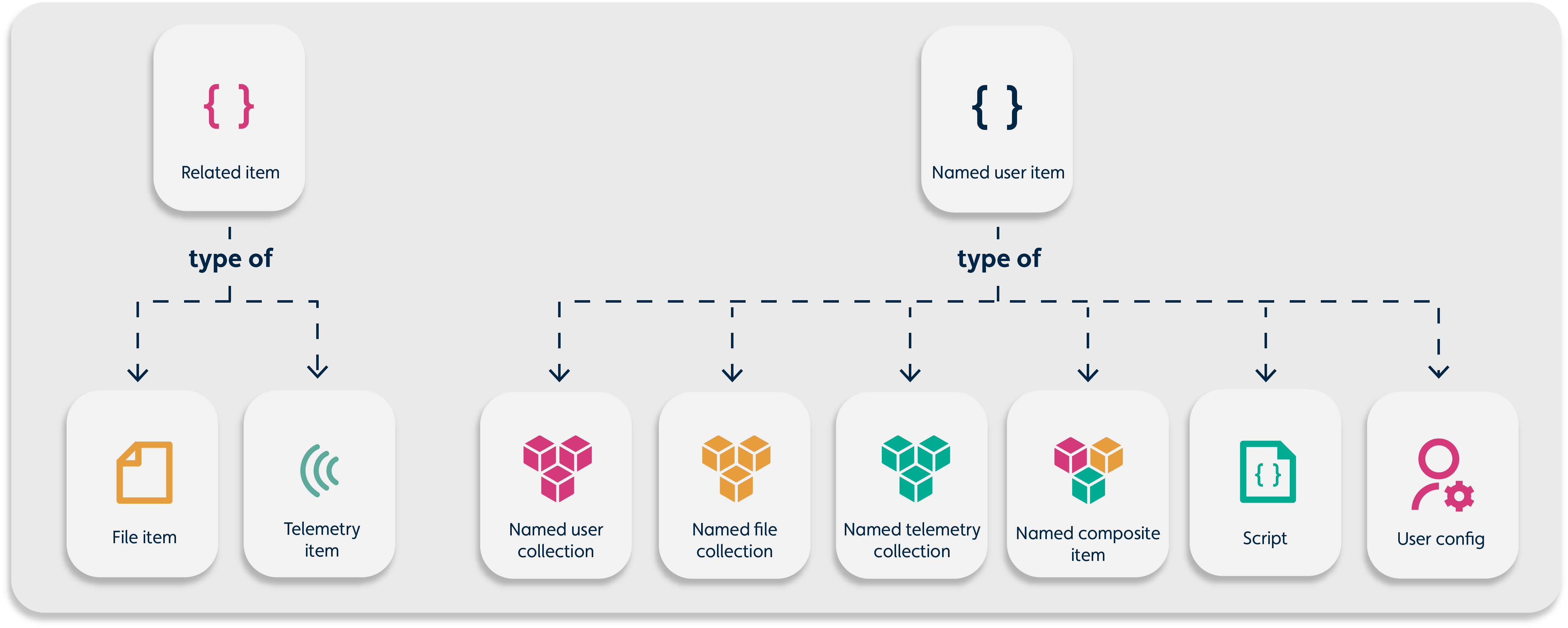
For more information on each usable data type, see the following graphic and table:

| Component | Description |
|---|---|
| RelatedItem | The most basic data structure that represents a single item as an object. A RelatedItem can be related to one or more other RelatedItems. |
| File item | A type of RelatedItem that represents a source file that is stored in the file service as a file item in the Item Service. |
| Telemetry item | A type of RelatedItem that represents a telemetry item in the Item Service, such as a specific device sensor. |
| Named user collection | A collection that groups RelatedItems. |
| Named file collection | A collection that groups file items. |
| Named telemetry collection | A collection that groups telemetry items. |
| Script | A business logic script you define. |
| User config | A front-end user configuration definition. |
| Named composite item | A collection that groups a variety of Item Service data types. |
Relationships#
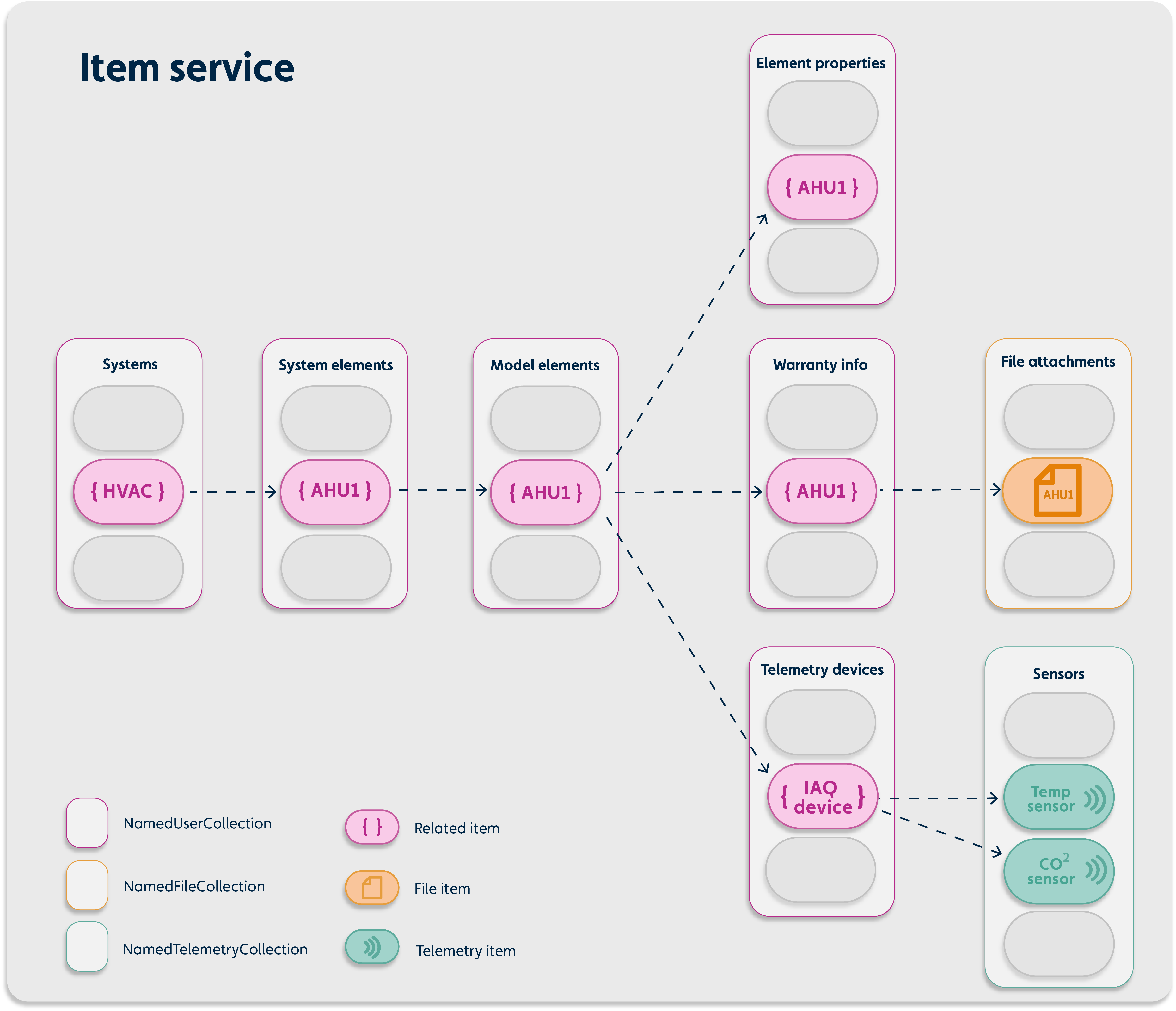
Use relationships to link RelatedItems semantically and query data by relationships.
The following graphic shows an example of an air handling unit represented as RelatedItems across named user collections, as well as a file item in a named file collection, and a telemetry item in a named telemetry collection. The graphic also demonstrates the relationships between the relevant items.
For more information on relationships, see Relationships.
Metrics Service#
The Item Service now has a new Metrics Service feature which was introduced in Platform version 4.4. This feature can record system events related to the Item Service and provide useful insights into the usage of a range of system resources.
To learn more about this new service, refer to Metrics Service overview.
API#
You can interface with the Item Service using the IafItemSvc JavaScript Platform API or the Item Service REST API.